
The Nvidia’s $2B Synopsys purchase in 2025 has shaken the global tech and finance sector not just because of its large $2 billion price tag, but because it marks the next major leap in AI-driven chip innovation. Nvidia, already the world’s most influential AI-chip company, has been on a tremendous investment campaign, and this latest move strengthens the assumption that the AI boom is still accelerating.
You need to know Synopsys in order to comprehend the significance of this agreement. It is the industry leader in Electronic Design Automation (EDA) software, which is a highly sophisticated technology used in semiconductor chip design and verification. Every contemporary gadget you use, including laptops, cellphones, cloud servers, electric cars, gaming consoles, medical equipment, and even AI assistance, requires chips made with Synopsys software. They are the “blueprint tools” behind the entire semiconductor ecosystem.
By investing in Synopsys, Nvidia is becoming a part of the chip manufacturing industry rather than merely purchasing stock. Faster chip design leads to faster innovation, which in turn leads to the earlier release of more potent gadgets. It’s the kind of action that changes technology roadmaps and establishes the standard for the most cutting-edge AI gadgets in 2026.
The major question now: How far will this alliance push the next generation of AI hardware?
The Deal Breakdown:
Nvidia’s $2B Synopsys
Nvidia has officially purchased $2 billion worth of Synopsys shares, paying $414.79 per share – acquiring around 2.6% ownership in Synopsys. The transaction quickly lifted Synopsys’s valuation, demonstrating market confidence and generating global conversations about Nvidia’s long-term intentions.
This isn’t a passive holding. It’s part of a new multi-year strategic alliance incorporating Nvidia’s GPU-accelerated AI capabilities directly into Synopsys’s EDA, simulation, and chip-design platforms.
According to Reuters:
“Nvidia’s investment strengthens a strategic partnership that is already expanding with the goal of integrating AI acceleration into fundamental semiconductor design processes.”
TechCrunch also mentioned:
“ThenNvidia Synopsys deal 2025 investment tightens Nvidia’s grip on the semiconductor stac positioning it at the heart of both AI-chip creation and AI-chip execution.”
As part of this collaboration:
Synopsys will transfer essential CPU-heavy chip-design processes onto Nvidia GPUs, speeding up simulation, layout, and physical verification.
Nvidia gains control over the software that global chipmakers Qualcomm, Samsung, Apple, Intel, AMD all rely on.
Both businesses will co-develop AI-powered chip-design methods that substantially shorten the time needed to produce next-gen silicon.
This move comes following Nvidia’s tremendous success with the H100 and increased demand for AI accelerators. By involving itself upstream in chip design rather than just chip manufacture. Nvidia is strengthening dominance across the whole semiconductor pipeline.
The strategic message is clear: Nvidia wants to own not just the future of AI technology, but the tools required to produce that hardware.

Tech Impact
Quicker AI Chips in Every Industry
The Nvidia Synopsys agreement 2025 is projected to speed up semiconductor creation cycles across smartphones, AI servers, consumer electronics, autonomous vehicles, and edge-AI devices.
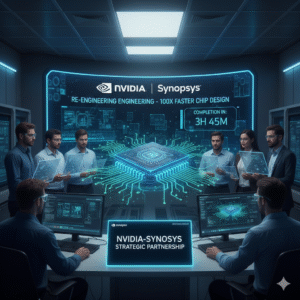
By incorporating Nvidia GPUs into the EDA pipeline, processes that traditionally require days may be accomplished in hours allowing organizations more freedom for experimentation, optimization, and quick iteration.
Potential Impact on 2026 Flagship Devices
Next-generation consumer electronics might be one of the biggest beneficiaries. Industry leaks already imply that early 2026 flagships including the predicted Samsung Galaxy S26 will rely significantly on AI-optimized chip architectures. Faster design cycles mean:
AI cores that are more effective
Higher-performance GPUs in phones
Improved image processing
Stronger on device AI assistants
Even early AI-generated video features
All of this depends on advanced silicon silicon that Synopsys’s tools help build.
Advancements in Quantum & Edge AI
Additionally, the collaboration improves the pipeline for models of experimental computing like:
Design of semiconductors influenced by quantum mechanics
Neuromorphic chips
Hybrid AI-class and physics-based processors
Smart edge-AI chips for IoT, AR, and robotics applications
Researchers can now investigate prospective chip structures that were previously too costly or difficult to model thanks to Nvidia’s acceleration of atomic-level and electromagnetic simulation inside Synopsys tools.
Pros & Cons of This Acceleration
Pros
Faster innovation cycles across the whole semiconductor industry
Lower design expenses through GPU-accelerated simulation
More potent AI chips will be available sooner.
Democratization of sophisticated chip tools for smaller businesses
Cons
Monopoly worries : Nvidia is now affecting both chip design and chip deployment.
Industry dependence : if Nvidia controls the design tools, alternative architectures may struggle
Regulatory scrutiny : governments may question Nvidia’s growing vertical consolidation
Supply chains may be strained by increased chip-cycle pressure and rapid obsolescence.
This deal could reshape the balance of power among chipmakers with Nvidia now sitting at the center of both hardware and design.
Conclusion & CTA
The Nvidia’s $2B Synopsys 2025 is more than a financial transaction it’s a significant moment in the advancement of AI-powered semiconductor architecture. The semiconductor industry as a whole may experience a sharp acceleration as these two titans combine their strengths: quicker chips, smarter gadgets, and a new wave of innovations in 2026 and beyond.
But this acceleration also poses important problems regarding competition, control, and long-term market stability. One thing is certain: this collaboration will influence AI hardware in the future.



good