
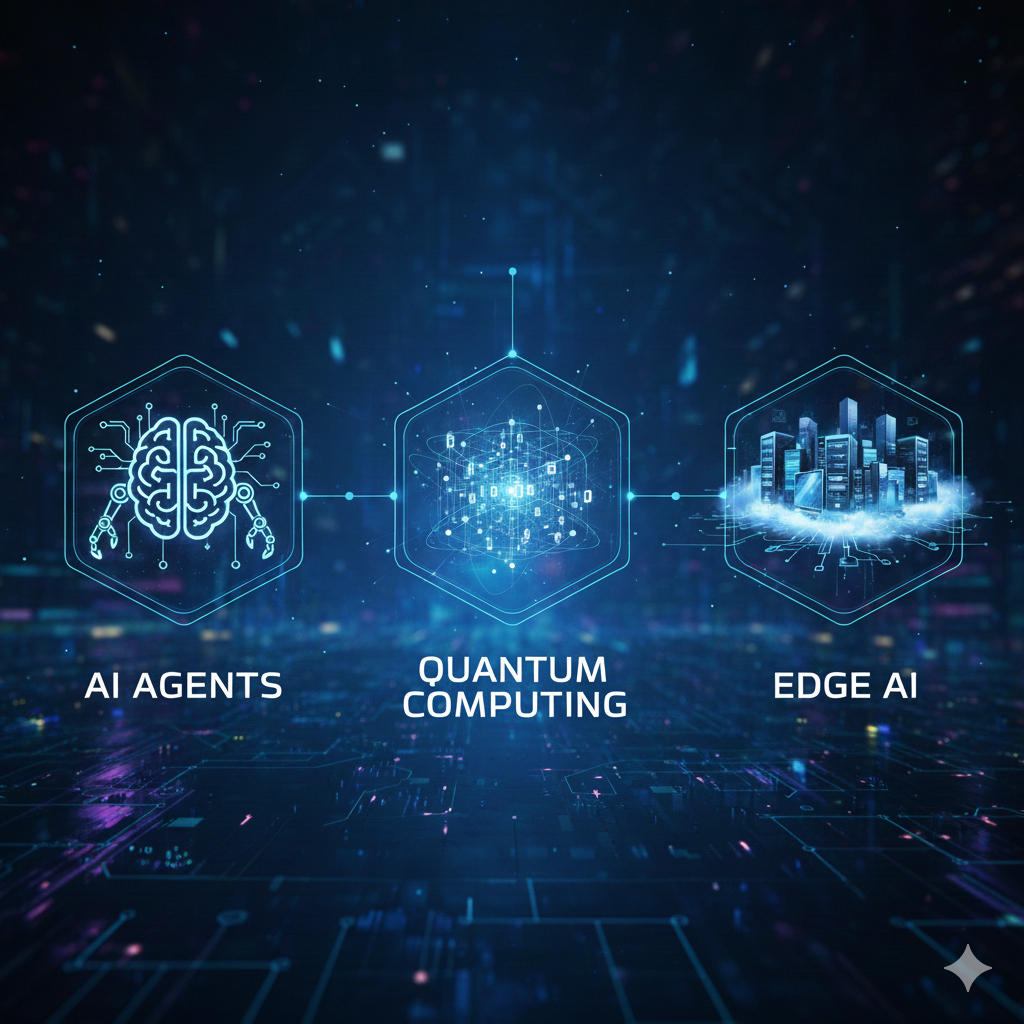
The year technology trends 2026 is shaping up to be one of the most transformational years in modern tech history. The rapid acceleration of AI, breakthroughs in chip design, quantum computing milestones, and a global shift toward sustainable and spatial technologies are reshaping every industry — from finance and healthcare to entertainment, manufacturing, and consumer electronics.
According to global analysts, emerging research posts by AI engineers, and major 2025 forecasts (from Gartner, WEF, Forbes, and leading tech strategists), 2026 will be the year AI becomes “everywhere, invisible, and unavoidable.”
This isn’t hype. It’s the result of years of R&D, hardware innovation, and shifting market demand converging at the same time.
Below is the complete breakdown of the Top 10 Tech Trends that will define 2026 and how these forces are expected to reshape global business, jobs, and digital infrastructure.
Why 2026 Will Be the Year of AI Everywhere
Every indicator points to technology trends 2026 as the year where AI stops being a feature — and becomes the foundation of business operations, product design, national strategy, and everyday consumer life.
Three forces are driving this shift:
1. AI Agents Becoming Mainstream
Thanks to new agentic frameworks, businesses will deploy automated digital workers capable of research, planning, scheduling, coding, customer support, and financial analysis.
X-social posts by top AI engineers show that the AI Engineering Stack for 2026 revolves around:
autonomous reasoning modules
edge execution
retrieval-enhanced planning
multimodal interaction
These agents don’t just “execute” tasks — they think, plan, and optimize.
2. Accelerated Hardware Innovation
With GPU improvements, edge chips, and hardware-accelerated AI design (influenced by companies like Nvidia, AMD, Apple, and Qualcomm), next-gen devices will be faster and more capable.
3. Global AI Regulation + Adoption
The US, UK, India, and EU are pushing national frameworks for safe AI use, while also investing in talent, cloud infrastructure, and testing sandboxes.
This creates the perfect environment for AI to embed itself into every workflow, device, and economic sector.
1–3: AI Agents, Generative AI & Multimodal Models
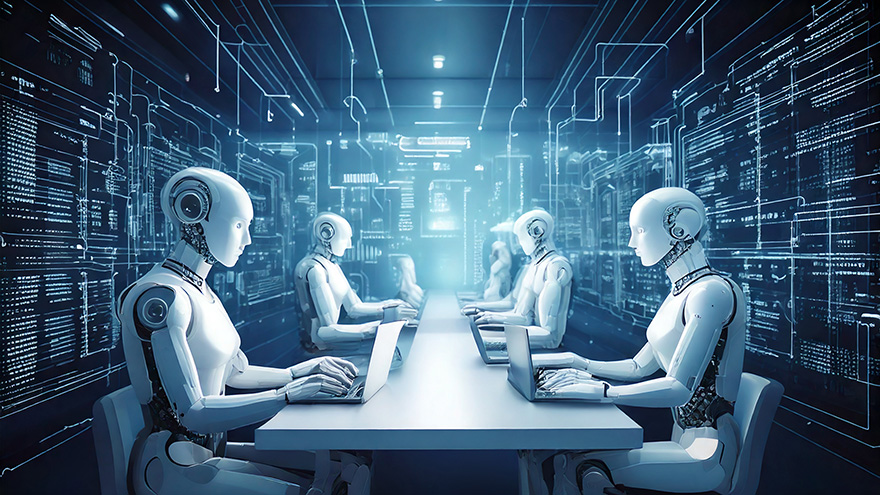
1. AI Agents Replace Traditional Automation
2026 AI agents will behave like “digital employees.”
Businesses will use them for:
Customer support
Market research
Data cleaning
Marketing execution
Software debugging
Legal document summarization
HR screening
Unlike 2020s assistants, these agents self-learn and self-correct, making them significantly more powerful.
Large enterprises will deploy “agent orchestration hubs” to manage multiple agents per department — a new category predicted by Gartner for 2026.
2. Generative AI Evolves Into Enterprise Intelligence
GenAI will move beyond chatbots and content creation.
In 2026, we’ll see GenAI used for:
Real-time business dashboards with predictive recommendations
Auto-generated product designs
Automated code deployment
AI-driven video creation
Digital twins of supply chains
Companies like OpenAI, Google, Anthropic, and Meta will release multimodal enterprise suites, where text, images, audio, video, and 3D operate in one unified ecosystem.
3. Multimodal Models Become Standard AI Infrastructure
Multimodal AI — which understands and generates across multiple formats — will power:
autonomous vehicles
industrial robots
AR glasses
medical diagnostic tools
smart home ecosystems
For the first time, businesses will treat multimodal models like they treat databases: standard, necessary, embedded into everything.
4–6: Quantum Computing, Edge AI & 6G Networks
4. Quantum Computing Moves From “Experiment” to “Enterprise”
WEF’s Future of Jobs Report predicts a surge in demand for quantum engineers by 2026.
Quantum breakthroughs will impact:
pharmaceutical simulations
climate modeling
financial forecasting
cybersecurity
material sciences
While we won’t see full-scale quantum computers replacing classical hardware yet, 2026 will be the year hybrid quantum-AI architectures hit mainstream enterprise use.
5. Edge AI Explodes (Smarter Devices, Less Cloud Dependency)
Edge AI — running intelligence locally on devices — will dominate smartphones, IoT, cars, wearables, and industrial sensors.
Thanks to lighter models + powerful chipsets, 2026 devices will feature:
on-device AI assistants
real-time video generation
ultra-fast image processing
offline translation
advanced AR experiences
This aligns with the 2026 AI Engineering Stack, which emphasizes privacy-first, low-latency AI at the edge.
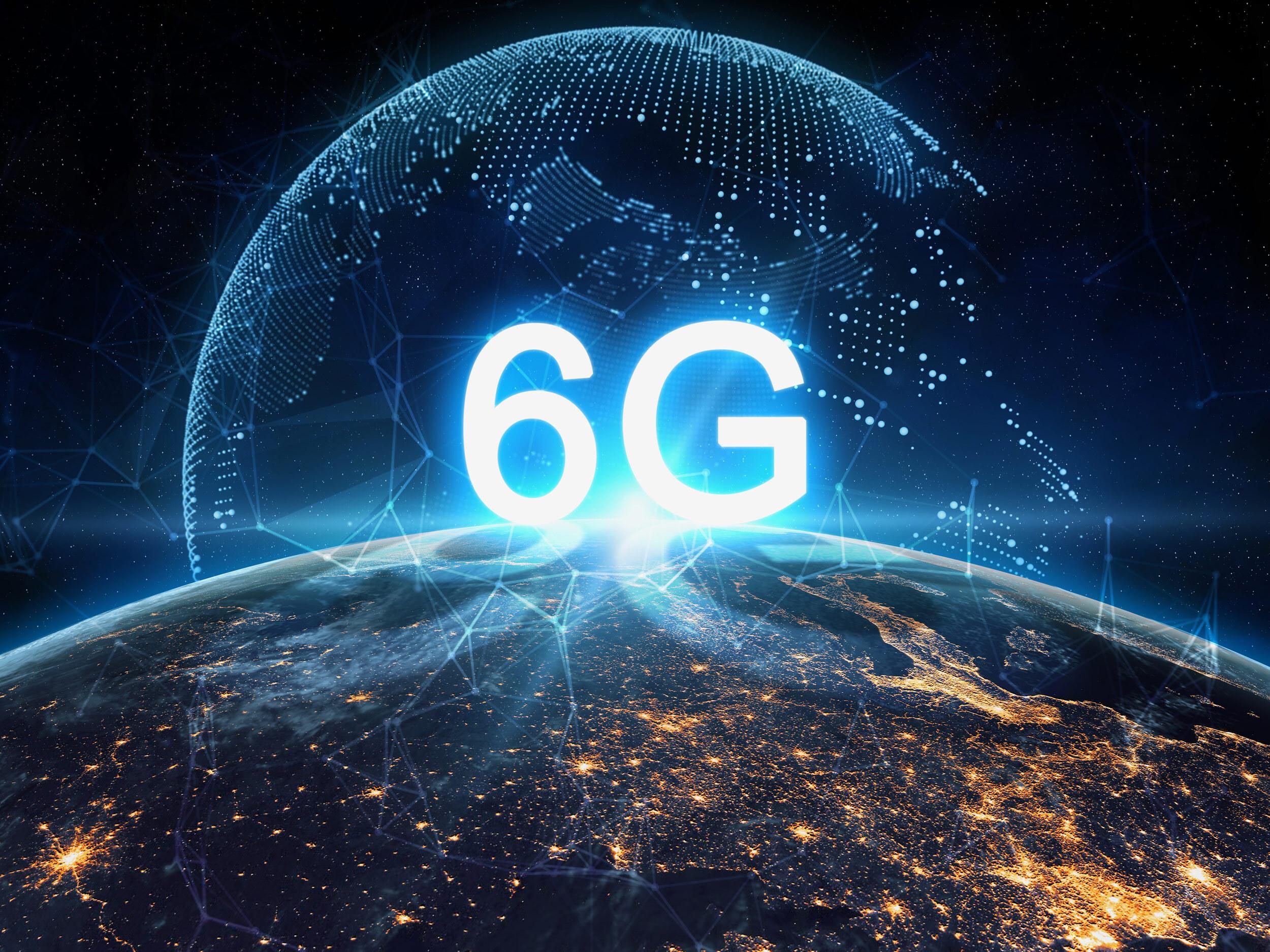
6. 6G Networks Begin Early Rollout
Although mass adoption will peak around 2028–2030, 2026 marks the first commercial stage of 6G testing.
Expected features include:
speeds up to 1 TB/s
sub-millisecond latency
real-time holographic communication
connected robotics swarms
smart mobility systems
6G + Edge AI + spatial computing will become the “holy trinity” of next-gen tech experiences.
7–10: Sustainable Tech, Spatial Computing & Biotech Fusion
#7. Sustainable Tech Becomes Mandatory, Not Optional
Expect:
carbon-tracking embedded into cloud services
green data centers
AI-optimized energy grids
sustainable manufacturing workflows
By 2026, governments will enforce stronger ESG reporting, forcing businesses to adopt green tech at scale.
8. Spatial Computing Goes Mainstream After Apple Vision Success
With the mass adoption of Vision Pro and competing devices from Meta, Samsung, and HTC, 2026 will see:
spatial offices
3D meetings
virtual storefronts
hologram-based learning
medical spatial imaging
Forbes highlights spatial computing as a “multi-trillion ecosystem” forming this decade.
9. BioTech x AI Fusion Accelerates Healthcare Transformation
Expect a rise in:
AI-driven drug discovery
Genomic editing tools
Bio-AI wearable sensors
Personalized medicine platforms
Predictive health becomes reality for consumers by 2026.

10. AI + Crypto + Real-World Assets (RWA) Converge
According to Cointelegraph forecasts, 2026 will bring:
AI-powered crypto trading
RWA tokenization for property, gold, carbon credits
decentralized AI agent networks
AI becomes the backbone of financial automation.
Global Impact: USA Startups, UK Regulations, India Adoption, Europe Ethics
USA: Startup Boom & AI Agents Everywhere
The US will lead in:
Agentic workflows
AI-driven cloud services
robotics
biotech x AI platforms
Venture capital will focus heavily on AI agents, edge devices, and enterprise automation tools.
UK: Regulatory Innovation + AI Sandboxes
The UK will expand its AI governance, implementing:
strict transparency laws
AI model safety guidelines
enterprise testing sandboxes
The UK emerges as a global regulatory leader.
India: The World’s Fastest AI Adoption Market
India will dominate via:
low-cost AI tools
government-backed digital infrastructure
large developer community
AI-enabled SMEs
India becomes the #1 emerging AI market in 2026.
Europe: Ethics, Data Protection & Sustainable AI
The EU will enforce more:
AI transparency rules
green compute standards
labor impact assessments
Europe positions itself as the global center for responsible AI.
How Businesses Can Prepare (Roadmap & Tools)
Immediate Steps (Q1–Q2 2026)
Deploy AI agents for internal workflows
Audit data pipelines for AI-readiness
Train employees in AI/ML core skills (Top skills per @TTechFusionist 2025 report)
Mid-Term Steps (Q3–Q4 2026)
Move toward edge-AI compatible devices
Adopt multimodal enterprise AI tools
Conduct AI ethics, security, and compliance checks
Long-Term Strategy (2027 and beyond)
Experiment with quantum-hybrid tools
Invest in spatial workspaces
Transition toward sustainable cloud infrastructure
By following this roadmap, businesses build competitive advantage while preparing for future regulatory environments.
Risks & Challenges Ahead
Despite the excitement, 2026 brings real concerns:
AI workforce displacement
software dependency
monopolization of AI stacks
cybersecurity threats
ethical misuse of AI agents
increased regulatory burden
Organizations will need stronger governance to navigate these risks effectively.
Final Predictions: The 2026 Tech Winner
AI Agents + Edge AI will be the winners of 2026.
Why?
Because every device, workflow, and business system will rely on them.
AI becomes:
faster
localized
multimodal
autonomous
context-aware
2026 won’t just be another tech cycle.
It will be the beginning of an AI-centric global economy, where intelligence — not hardware — becomes the real operating system of the world.


Very Good
Excellent
vgood
Pingback: Technologies Business in 2026